Part One · Comfort and Caution
A Search for Faith · Philippines
Between Pews and Pride
Begin reading
12 min read
Prologue
In the Philippines, Catholicism is woven into the fabric of family life. It shapes the week's rhythm, the home's routines, and the quiet expectations passed between generations. Faith is not something many Filipino families discuss or debate. It is simply present, in the rosary hung near the bedroom door, in the grace said before dinner, in the alarm set before dawn during Simbang Gabi, and in the assumption, seldom spoken aloud, that to be a good son means to follow a particular kind of path.
For many Filipinos, this religious framework offers genuine comfort. It provides structure, community, and meaning that feels inherited rather than chosen, and all the more secure for it. Yet for many LGBTQ Filipinos, the same framework can produce a specific kind of tension. They grow up inside a tradition that speaks often of love and acceptance, while learning, through smaller signals, that some versions of themselves may not be fully welcome.
This feature follows John, a twenty-year-old gay Catholic student navigating the space where his faith and his identity meet. His story is not a simple account of religion versus queerness. It is about the more difficult work of learning to hold both, without requiring either to disappear.
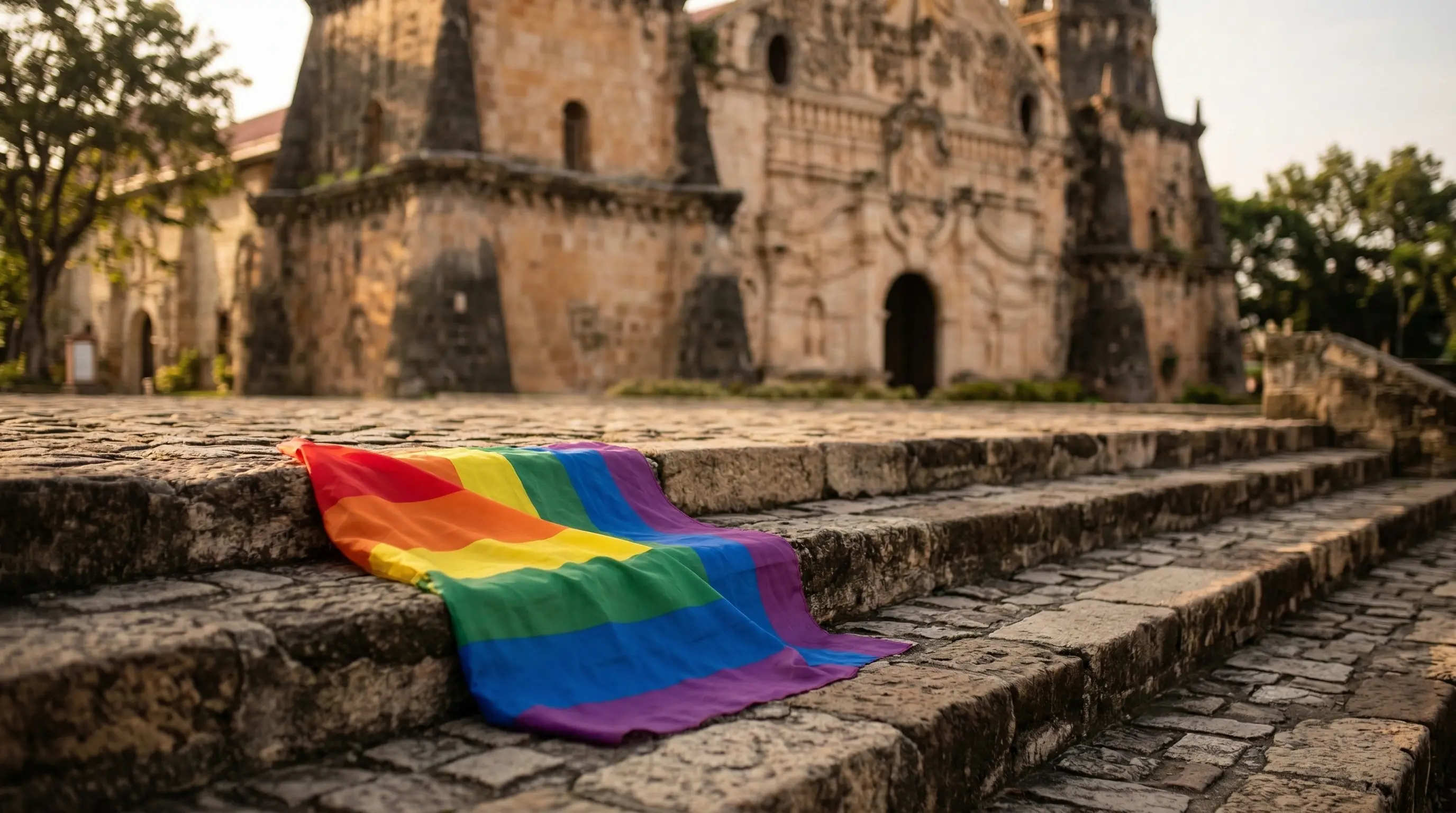
Two languages of belonging, spoken in the same place.
A Place of Comfort, A Place of Tension
On Sundays, John still goes to Mass.
He notices the details first. The hush before the opening hymn. The soft glow of candlelight near the altar. The polished wood of the pews, worn smooth by years of hands and prayer books and kneeling bodies. These things have not lost their power over him. They still settle something inside him. They carry the texture of his childhood, of Sunday mornings shaped by routine and family proximity, of a faith that arrived before he had the language to question it.
But he does not arrive at church the way he once did.
There is a nervousness now, a self-consciousness that surfaces before the service even begins. He is aware of how he holds himself, how he looks, whether anything about him reads as different. When a homily turns toward the right kind of family, or the proper shape of love between a man and a woman, something in him tightens. He has learned to sit with it quietly, to let the words pass over him without letting them fully land. The church still gives him peace. But that peace is no longer uncomplicated. It arrives alongside a vigilance he cannot entirely set down.
"I realized God didn't need me to be straight. The church might, but God didn't."
Part Two · Carrying the Cross
Carrying the Cross
John grew up in a very Catholic household. Sunday Mass was not optional. His mother prayed the rosary almost every night, the soft murmur of it audible through the walls. In December, the family tried to complete Simbang Gabi, the nine-day series of dawn Masses that carries its own particular devotion: the early cold, the quiet streets, the candles lit before sunrise. These were not burdens for him then. They were simply the shape of the year.
He began to realize he was gay around twelve or thirteen. It was not a sudden clarity so much as a slow accumulation of knowledge he did not yet know what to do with. For a time he held it apart from everything else, separate from the faith that structured his family and his daily life. But the two things could not stay separate for long.
The conflict sharpened at church and at family gatherings. He heard comments from older relatives, half-jokes about gay people said within earshot, the kind of laughter that is not quite directed at anyone in particular but still lands somewhere specific. He sat through homilies that described the right kind of family and understood, without needing to be told directly, that the family being described was not one that included him as he actually was. He laughed at the jokes when he had to. He kept his face still during the homilies. He learned, early and well, how to make himself difficult to read.
The effort was exhausting in a way that is hard to describe to someone who has never had to perform it. It was not that he disbelieved his faith. It was that he was learning to carry it alongside a part of himself that the faith, as it was being presented to him, did not seem to have room for.
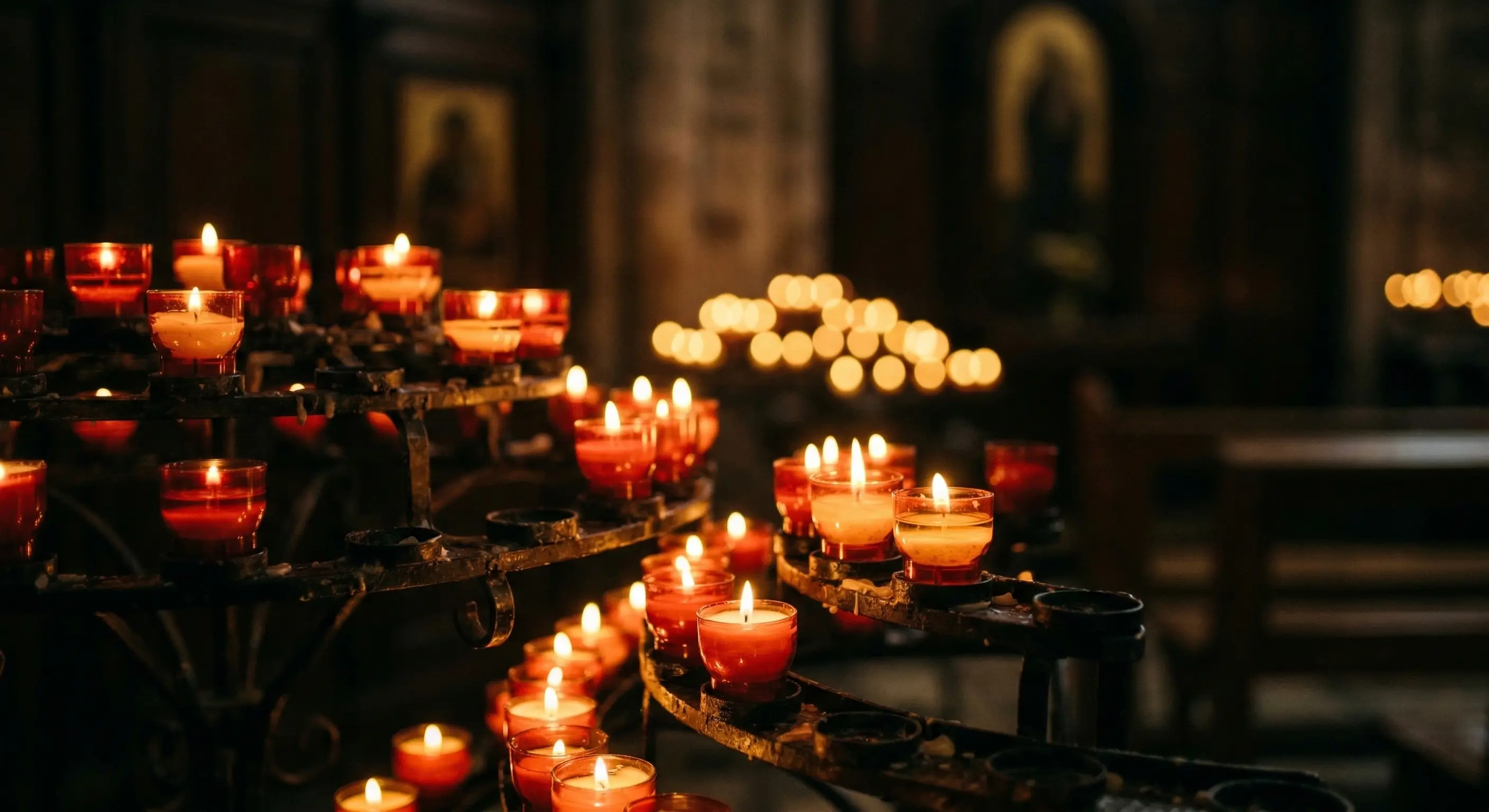
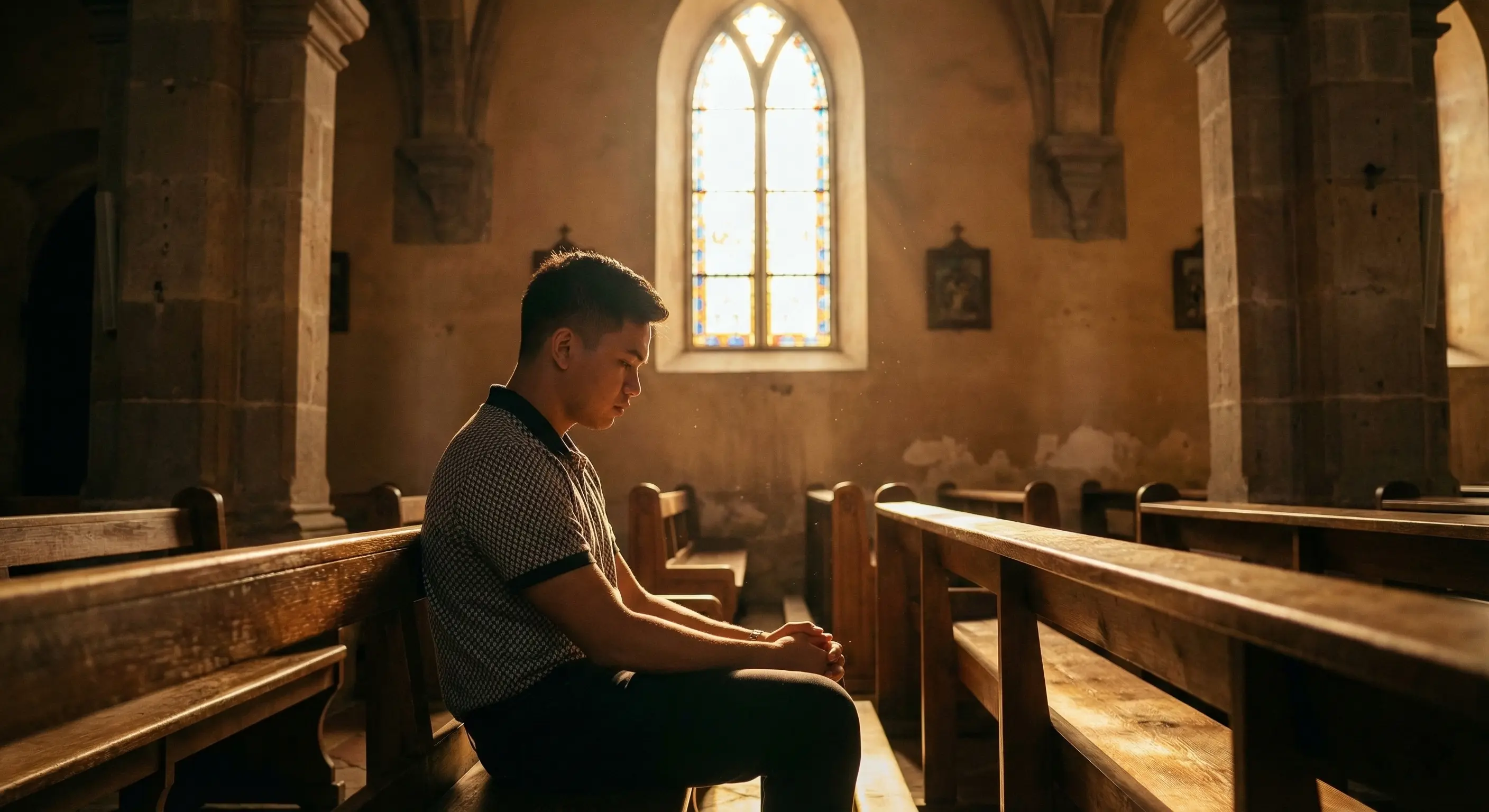
Devotion and concealment, held in the same body, in the same pew.
Part Three · A Soul Unveiled
A Soul Unveiled
For a long time, John believed that being gay was itself sinful. This was not something he arrived at through his own reasoning. It was simply the air of the world he had grown up in, absorbed through homilies and offhand comments and the silence around certain subjects. He prayed to be changed. He asked God, with genuine seriousness, to make him into someone the Church would not have to hold at a distance.
Gradually, that belief began to loosen. He came to understand sin differently, less as a condition of being and more as a question of action: of whether a person causes harm, of whether they practice cruelty or compassion. He could not locate cruelty in who he was. What he could locate was the harm done by shame, by hiding, by the slow erosion of a self that had never been given permission to exist openly.
He thought seriously about leaving the Church. It would have been a reasonable choice, perhaps even an obvious one. But what kept him was a distinction he had come to make carefully: between the institution and his faith in God, which felt, to him, like something that had existed before any institution and would outlast any particular failing of one. He did not want to walk away from God because some people speaking in God's name had made him feel small.
Support came from close friends who knew him fully and did not require him to edit himself in their presence. It also came, more unexpectedly, from online communities of queer Catholics, people managing the same contradictions he was, trying to remain inside a tradition they loved while being honest about who they were. He found, in time, a small group of queer Catholics who met informally to pray and talk together. It was not a formal ministry or an organized movement. It was simply a few people gathering with shared questions, and it gave him something he had not known he was missing: the experience of being both gay and Catholic in the same room, without having to choose which one to set aside.
Interview Transcript
"Before, I used to pray that God would change me. I really believed something about me had to be fixed. But over time I started to think differently about what sin even means. I don't think being gay is a sin. I think sin is about hurting people, about not having compassion. I couldn't find that in myself just for being who I am. So my prayers changed. I stopped asking to become someone else and started asking for peace, for honesty, for the strength to stop hiding. Faith became less about fear and more about being truthful."
John, 20
"Peace, for me, means not feeling like I have to choose between being gay and believing in God."
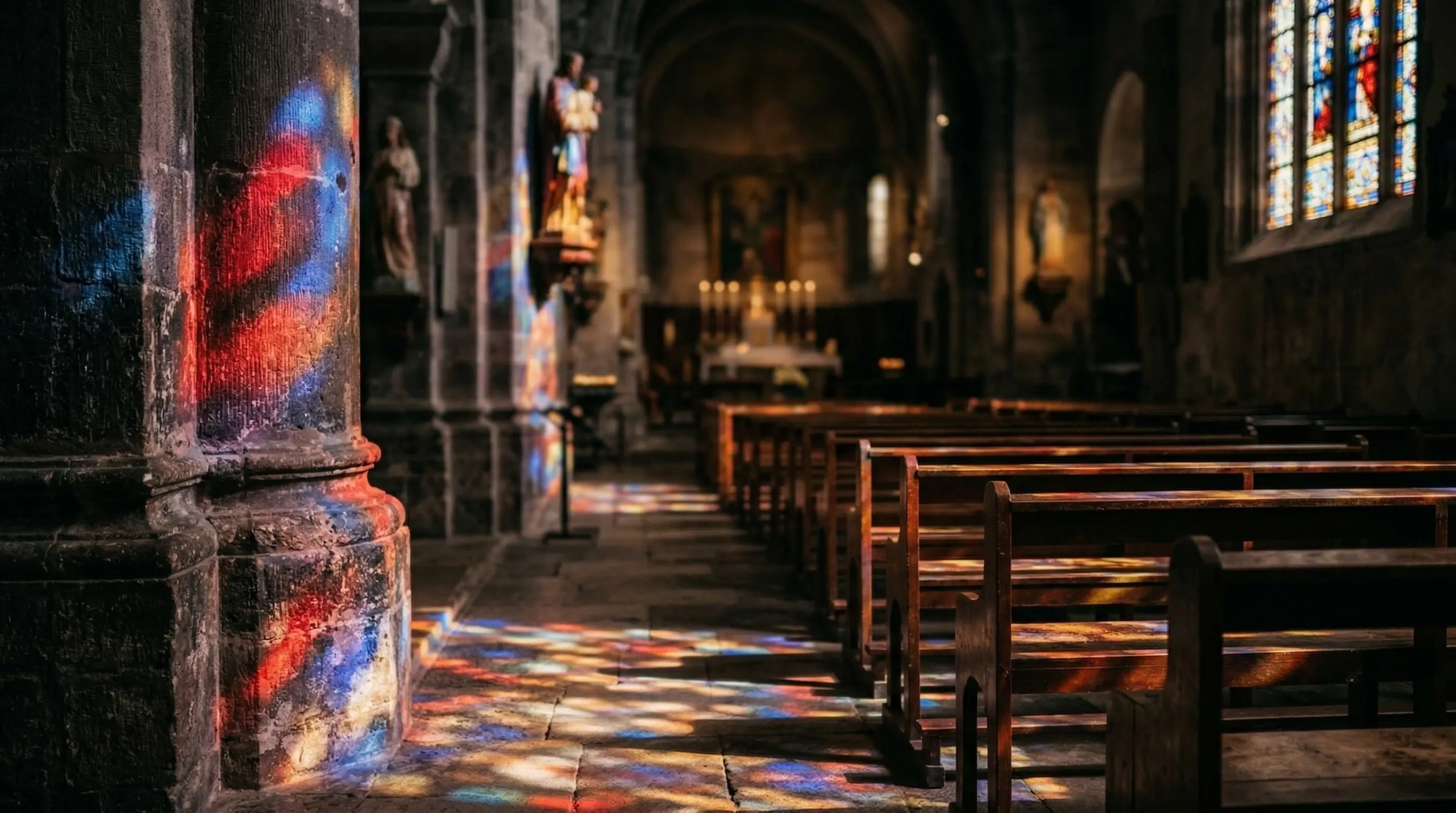
The same window. A different way of standing in its light.
Epilogue · Whole at Last
Whole at Last
On a recent Sunday, John went to Mass alone. Not with family, not out of obligation. He went because he wanted to. He chose a seat nearer the middle of the church than he used to sit. It was a small thing, and he knew it was a small thing. But it was different from before, when he would find a pew near the back, close to an exit, where he could be present without being too visible.
He wrapped his rosary around his fingers during the quiet parts of the service, the same rosary he had carried since childhood, a little worn now, the beads smooth from years of use. Afterward, he stopped at the row of votive candles near the side altar. He lit one. He did not pray to be changed. He prayed for the people he loved. He prayed for the queer Catholics he had met, the ones still finding their way. He prayed with the simple intention of someone who is, slowly and imperfectly, learning to take up a little more space.
John is still learning how to balance both parts of himself. He does not claim to have resolved the tension. The institution has not changed around him, and he knows it. There are still homilies that sting. There are still relatives whose love comes with conditions he cannot meet. But he no longer believes that the price of belonging to his faith is the disappearance of who he is.
His peace is not perfect. He says so directly, without self-pity. It is more real than the peace he was performing before, when he sat at the back and kept himself small. What he has now is quieter, more private, and more genuinely his. He is still inside the church. He is still holding the rosary. He is no longer asking God to make him someone else.
That, for now, is enough.
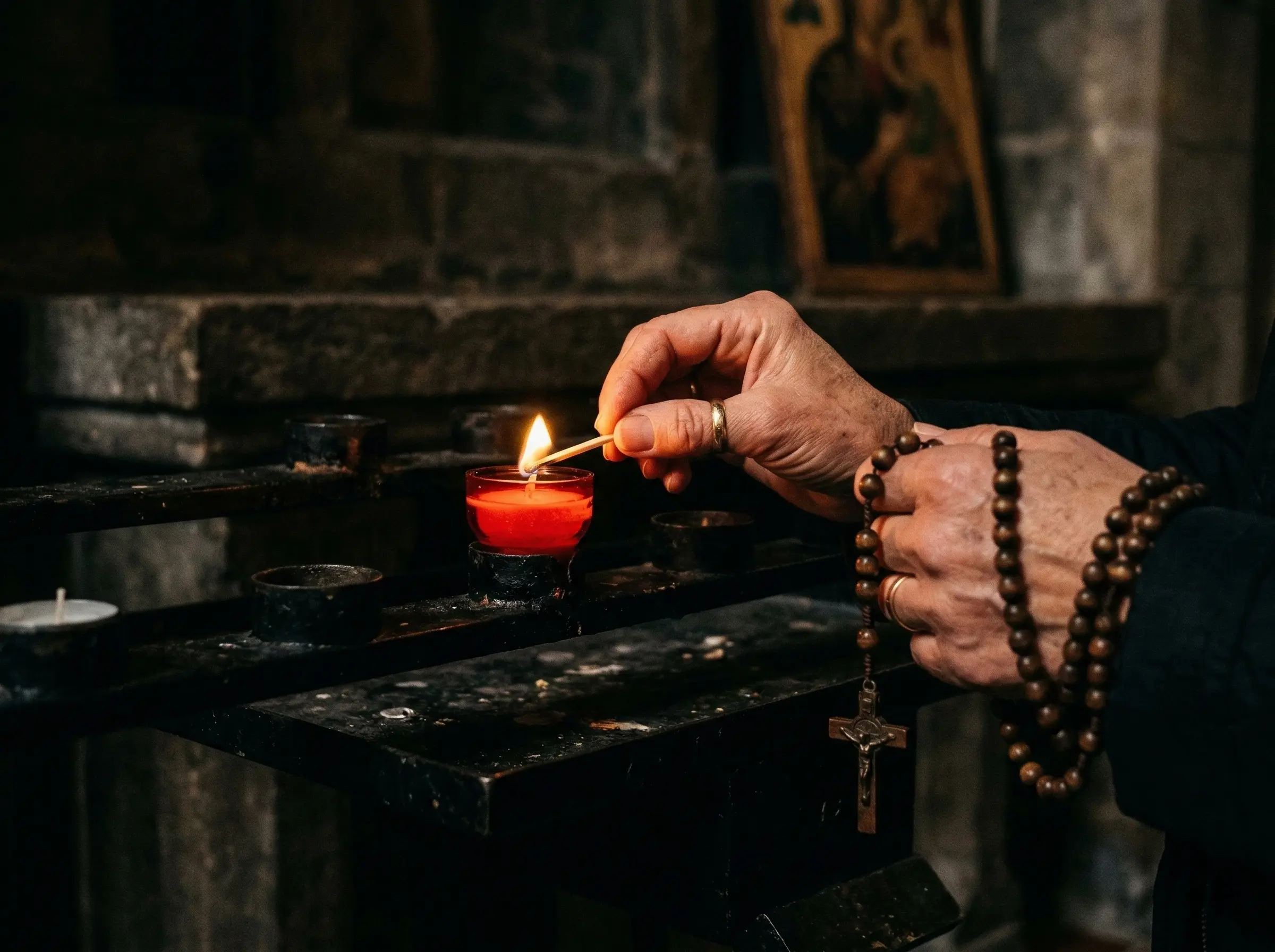
A candle lit not in petition, but in presence.
About the Authors
This feature story was written by students for a Gender and Society project. The authors are interested in how social institutions like religion shape identity, belonging, and personal experiences. Through this project, they hope to present a thoughtful narrative that explores the realities faced by LGBTQ+ individuals navigating faith and community in the Philippines.
Dzen Karl Rodriguez
Samantha Rylee Guillo
Katrina Liporada
Credits and Notes
Story developed for a Gender and Society project.
Interview subject: John, alias used to protect privacy.
Typography: Cormorant Garamond, EB Garamond, Instrument Sans.